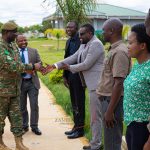
The National Remote Sensing Centre (NRSC) has signed a Memorandum of Understanding (MoU) with Solafune Inc. of Japan to strengthen cooperation in Earth Observation and Remote Sensing technologies in support of Zambia’s national development agenda.
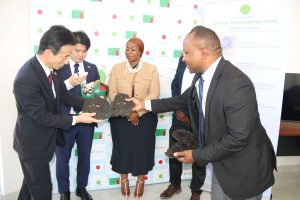
The MoU signing ceremony was held on 28 January 2026 at the Ground Receiving Station (GRS) in Chibombo District and marks an important step in enhancing international collaboration in the application of space and geospatial technologies.
The partnership aims to promote joint initiatives in Earth Observation applications, research collaboration, capacity building, and knowledge exchange, with a focus on supporting evidence-based decision-making across key sectors of the economy.
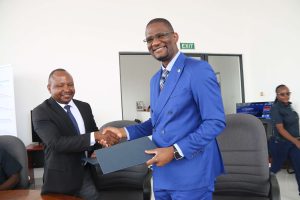
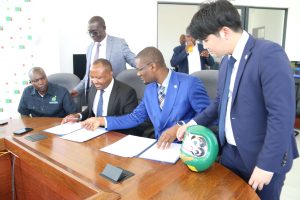


In his remarks, NRSC Director, Dr. Patrick Sibanda, stated that Earth Observation and space science are inherently collaborative fields that require strong institutional partnerships to deliver meaningful impact. He noted that the MoU represents the beginning of a broader programme of cooperation between NRSC and Solafune Inc., anchored on the long-standing Government-to-Government relations between Zambia and Japan.
Dr. Sibanda further emphasised NRSC’s commitment to enhancing the utilisation and visibility of Zambia’s Ground Receiving Station at both regional and international levels, adding that such partnerships are essential for the effective implementation of the Centre’s mandate in line with national development priorities.
Speaking at the event, Solafune Inc. Chief Executive Officer, Mr. Ren Uechi, described Solafune as a technology company that supports the Government of Japan in decision-making through the provision of Earth Observation and Remote Sensing-derived information.
He noted that Solafune applies satellite data and geospatial analytics across various thematic areas, including agriculture, mining, and environmental monitoring. Mr. Uechi reaffirmed the company’s commitment to fostering a partnership based on cooperation, trust, and mutual benefit, aimed at contributing to sustainable and resilient development.


Delivering remarks on behalf of the Permanent Secretary in the Ministry of Technology and Science, Mrs. Misozi Banda Kapeya highlighted that the MoU aligns with Zambia’s broader development framework, particularly the Eighth National Development Plan (8NDP).
She underscored the growing global importance of Earth Observation technologies, noting their contribution to improved agricultural productivity and enhanced planning and decision-making. Mrs. Kapeya described the Ground Receiving Station as a strategic national asset, stating that strengthening local data acquisition and hosting capabilities would support evidence-based policy formulation and implementation across Government institutions.
She further noted that the collaboration aligns with national priorities on climate resilience and agricultural development, especially considering Zambia’s reliance on rain-fed agriculture. She encouraged both parties to ensure that the MoU is operationalised and delivers measurable outcomes.
In his keynote address, NRSC Board Chairperson, Mr. Samuel Maango, described the MoU as a strategic milestone for the Centre. He observed that Earth Observation and geospatial intelligence have become critical enablers of modern development planning across multiple sectors.
Mr. Maango stated that the partnership with Solafune Inc. will support NRSC’s transition towards advanced geospatial analytics, including Geospatial Artificial Intelligence, and will contribute to strengthening institutional capacity and technical expertise.
He concluded by affirming that the MoU represents the foundation of a long-term collaboration aimed at advancing innovation, research, and service delivery in Earth Observation and Remote Sensing.