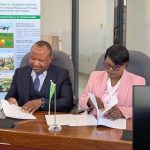
The National Remote Sensing Centre (NRSC) and the Zambia Revenue Authority (ZRA) have signed a Memorandum of Understanding (MoU) aimed at strengthening collaboration in the application of Earth Observation, remote sensing, and geospatial technologies to support revenue administration and regulatory compliance in Zambia.
The strategic partnership marks an important milestone in leveraging innovative technologies to enhance tax administration, improve resource governance, and support evidence-based decision-making in key sectors of the economy.
Under the agreement, the two institutions will collaborate in the areas of Property Transfer Tax administration and mining sector compliance monitoring. The partnership seeks to harness satellite imagery, Geographic Information Systems (GIS), remote sensing technologies, and spatial data analytics to strengthen the identification, monitoring, and assessment of economic activities that contribute to domestic revenue mobilisation.

In the area of Property Transfer Tax, the collaboration will focus on the utilisation of geospatial technologies to support property identification, valuation verification, land-use monitoring, and the detection of property developments and transactions that may have tax implications. The use of Earth Observation data is expected to improve the accuracy and efficiency of tax administration while supporting enhanced compliance and transparency in the property sector.
The partnership will also support efforts to strengthen monitoring and compliance within Zambia’s mining sector. Through the application of satellite-based monitoring and geospatial analysis, NRSC and ZRA will work together to develop innovative approaches for identifying mining activities, monitoring operational footprints, detecting illegal or unlicensed mining operations, and supporting compliance verification for licensed mining entities.
The collaboration is expected to enhance ZRA’s ability to utilise modern technologies in revenue collection and compliance enforcement while providing NRSC with an opportunity to expand the practical application of Earth Observation and geospatial technologies in support of national development priorities.
Speaking on the significance of the agreement, both institutions highlighted the growing importance of data-driven approaches in public administration and resource governance. The partnership reflects a shared commitment to innovation, efficiency, accountability, and the utilisation of advanced technologies to strengthen service delivery and support sustainable economic development.
The MoU further provides a framework for knowledge sharing, technical cooperation, capacity building, joint research initiatives, and the development of geospatial tools and solutions tailored to Zambia’s unique taxation and mining governance challenges.
As implementation of the agreement commences, NRSC and ZRA look forward to translating the partnership into practical programmes and projects that will contribute to improved revenue mobilisation, enhanced mining sector oversight, and strengthened utilisation of space-based technologies for national development.
The collaboration underscores the Government of Zambia’s commitment to embracing innovation and digital transformation in public sector operations while maximising the benefits of geospatial technologies to support economic growth and sustainable resource management